ChatGPT for School Homework
Is your child using ChatGPT for homework? Here's what most students don't understand about AI — and the three questions every parent should be asking right now.
Let's not pretend this is a new conversation.
ChatGPT turned three years old and somewhere in that time, it quietly became part of how a significant chunk of Indian school students do homework. Not all of them. Not in every subject. But enough that most teachers know it's happening, most parents suspect it, and most students have at least tried it once — even if they won't say so out loud.
The interesting question isn't whether students are using it. They are. The interesting question is what they're actually getting out of it — and what they're not.
What's actually happening when a student opens ChatGPT for homework
Usually one of three things.
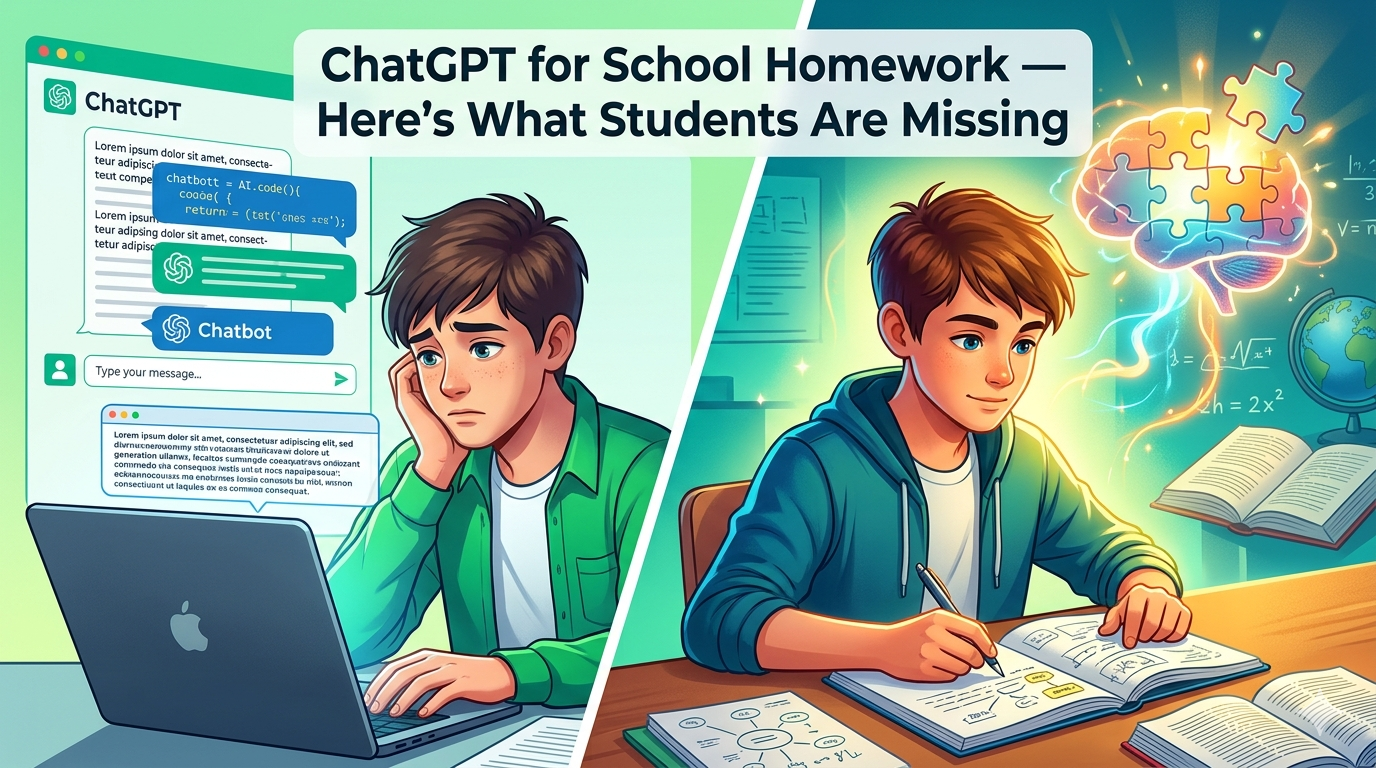
The first: they're stuck on something and they want it explained differently. The textbook version didn't land. The teacher moved on. It's late and there's no one to ask. They type the question in, read the answer, and something clicks. This is — genuinely — a good use of the tool. It's what a patient tutor would do, and for students in Tier 2 and Tier 3 cities where access to good tutoring is uneven, that matters.
The second: they're short on time and they want the homework done. They paste the question in, copy the output, change a few words, submit. This is the version that worries teachers. It's also, honestly, the version that's been happening since students discovered they could copy from each other or find solved guides at the bookstore. The technology is new. The behaviour is not.
The third — and this is the one nobody talks about enough — they're curious. They asked ChatGPT something and it gave them an interesting answer and they asked a follow-up and then another one and forty minutes later they know considerably more about the topic than the homework required. This happens more than you'd expect, especially with students who are already inclined to dig deeper.
Three very different uses. One tool.
The problem isn't ChatGPT. It's that students don't know what it is.
Here's something worth sitting with. Most students who use ChatGPT for homework have no clear idea how it actually works. They know it answers questions. They know it's sometimes wrong. They've probably been told not to trust it completely.
But they don't know why it's sometimes wrong. They don't know what it means for a model to "hallucinate." They don't know that ChatGPT isn't retrieving facts from a database — it's predicting likely text based on patterns in training data. They don't know that the confident, well-structured answer it gives them could be entirely fabricated and would look identical to a correct one.
That gap is a real problem. Not because it means students will get caught plagiarising — though that happens too — but because it means they're using a powerful, flawed tool without any framework for evaluating what it tells them.
A student who understands, even roughly, how a large language model works will interact with ChatGPT completely differently. They'll verify. They'll push back. They'll notice when something sounds right but feels off. They'll use it as a starting point rather than an ending point.
That's not a small difference. In a world where AI-generated content is everywhere and the skill of distinguishing reliable information from convincing nonsense is increasingly valuable — that difference is significant.
What schools are supposed to do with this
Banning it doesn't work. Schools that have tried know this. A student determined to use ChatGPT for homework will use ChatGPT for homework. The phone goes in the bag, the laptop stays at home, the output gets typed up by hand. Bans push the behaviour underground. They don't change it.
What does work — what the schools getting this right are actually doing — is teaching students to understand the tool rather than just use or avoid it.
When AI is part of the curriculum in a real way — not as a cautionary tale about plagiarism, but as a subject with depth — students start asking different questions. Instead of "will this get me caught," they start asking "is this actually correct" and "how would I verify this" and eventually "how would I build something like this."
That progression — from user to evaluator to builder — is exactly what a meaningful AI education looks like. And it starts well before Class 11. Students in Class 6 and 7 who learn what machine learning actually is, who run small experiments with data, who understand why an AI system makes the predictions it makes — those students are not going to blindly paste ChatGPT output into their homework and call it done. They know too much about what's under the hood.
A practical note for parents right now
If your child is using ChatGPT for homework, three questions worth asking them:
Did the answer make sense to you, or did you just submit it? Can you explain what it said in your own words? Did you check whether it was actually correct?
Not as an interrogation. As a conversation. The goal isn't to catch them doing something wrong — it's to build the habit of critical engagement with AI output. That habit, developed early, is worth more than any individual assignment.
And if their school is still treating AI as either a banned tool or an optional extra — rather than a subject worth understanding properly — that's a conversation worth starting with the school.
The students who will do well in the next decade aren't the ones who avoided AI or the ones who used it uncritically. They're the ones who understood it early enough to use it well.
AI for Schools partners with 250+ schools across India to bring real AI education into classrooms — from Class 3 to Class 12. Not just tools. Not just theory. Hands-on projects, Silicon Valley mentorship, and the kind of understanding that changes how students engage with technology for the rest of their lives. If you want your school to be part of this, reach out here.